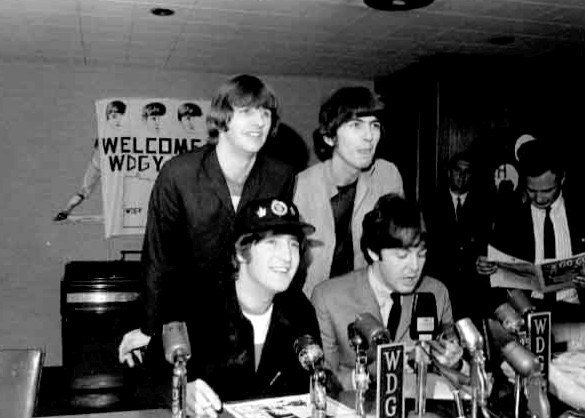
Photo: Minnesota Historical Society. Resized for this app.
Photo sourceCC BY-SA 2.0
Pop · 5 min read
The Beatles
The Beatles — Four Personalities, a World of Sound
The Beatles had a remarkable ability to make a song feel familiar without making it predictable. A melody might catch your attention immediately, while a small detail—a harmony, a guitar phrase or an unexpected change of direction—would give you a reason to listen again. Their music could be playful, tender, restless or strange, sometimes within the same track. Across their recordings, there is the pleasure of hearing four musicians discover just how far a song could go.
Coming out of Liverpool, John Lennon, Paul McCartney, George Harrison and Ringo Starr developed a group identity strong enough to hold four distinct personalities. Their early sound drew on rock and roll, rhythm and blues, and the craft of popular songwriting. They brought those influences together with sharp melodies, closely matched voices and performances full of youthful urgency. Even now, their early records have an energy that makes it easy to understand why people responded so strongly.
Songs such as “Please Please Me,” “She Loves You” and “I Want to Hold Your Hand” get to the point quickly. The excitement is in the singing, the rhythmic drive and the way each chorus seems ready to burst out of the speakers. These are carefully constructed songs, but they rarely feel laboured. Their directness is part of their strength: a few minutes are enough to establish a feeling and make it memorable.
As their songwriting developed, that emotional range widened. Love remained an important subject, but their songs began to explore doubt, frustration, memory and the difficulties of understanding other people. “Help!” carries an unsettled message beneath its lively pace. “Yesterday” gives regret a melody that feels almost conversational. “In My Life” looks back with affection while recognising that people and places change. These songs leave enough room for listeners to bring their own experiences to them.
Lennon and McCartney’s songwriting partnership was central to this growth. Their individual instincts could complement, challenge and sharpen one another. Lennon often brought a biting wit and an exposed emotional edge, while McCartney showed an extraordinary feel for melody, structure and storytelling. Neither fits neatly into a single category, though. Both could write with tenderness, both could be mischievous, and both were willing to explore unfamiliar musical ideas. The variety within their work matters more than any simple division between them.
Harrison added another increasingly important voice. His guitar playing often served a song through a well-placed phrase or a distinctive texture. As a songwriter, he developed a thoughtful presence that broadened the group’s emotional and musical character. “Something” has a graceful confidence, while “Here Comes the Sun” turns a feeling of relief into something you can almost hear unfolding. His interest in Indian music also helped introduce different instruments and approaches into the band’s recordings.
Starr gave the group a rhythmic foundation with considerable personality. His playing often feels natural enough to pass unnoticed at first, yet the drum parts are essential to how the songs move. He could give a performance weight, looseness or a slight sense of surprise without overcrowding it. His fills and accents frequently become part of a song’s identity. There is a generous quality to that approach: the drums help the whole performance make sense.
Albums such as Rubber Soul and Revolver reveal a band becoming more curious about arrangement, atmosphere and subject matter. Acoustic warmth sits alongside sharper electric sounds, while the writing moves between intimate reflections and unusual characters. “Eleanor Rigby” creates a powerful sense of loneliness through a small number of telling details and an urgent string arrangement. “Tomorrow Never Knows” explores a very different space, using repetition and swirling sounds to create something immersive and disorientating. The distance between those two songs shows how broad the group’s imagination had become.
With producer George Martin, The Beatles increasingly treated recording as part of the creative process. The studio allowed them to build sounds that went beyond a straightforward band performance. Orchestral instruments, tape effects and unusual combinations of textures became tools for expressing an idea. On Sgt. Pepper’s Lonely Hearts Club Band, that sense of possibility gives the music a theatrical atmosphere. “A Day in the Life” is especially striking for the way it moves from close, almost ordinary observations towards passages of enormous tension.
Their later work continued to reveal different sides of the group. The self-titled double album, widely known as The White Album, moves through acoustic intimacy, rough-edged rock, humour and experimentation. Its changes in mood can feel abrupt, but they also make it fascinating. Abbey Road brings a different kind of satisfaction, particularly when separate musical ideas begin to connect across its closing sequence. There is pleasure in the individual songs and in hearing how they contribute to a larger shape.
What makes The Beatles worth returning to is the detail within the music. Their reputation is enormous, but a listener can still encounter a song on a small, personal scale: a line that suddenly means more, a harmony heard properly for the first time, or a rhythm that changes the mood of a morning. Their finest recordings reward close attention while remaining easy to enjoy. Beneath the history are songs with enough character, warmth and curiosity to keep finding new listeners.
Watch The Beatles
You’ve Got to Hide Your Love Away
Watch on YouTube ↗YouTube loads when you press play. Some videos may need to open on YouTube.
Start with these
- Here Comes the Sun
- In My Life
- A Day in the Life
Listening opens in your chosen service. Availability and subscription requirements may vary.
What do you think?
Join the conversation about The Beatles.
Loading comments…