Favourites can only be kept while this window is open. Allow browser storage to keep them next time.
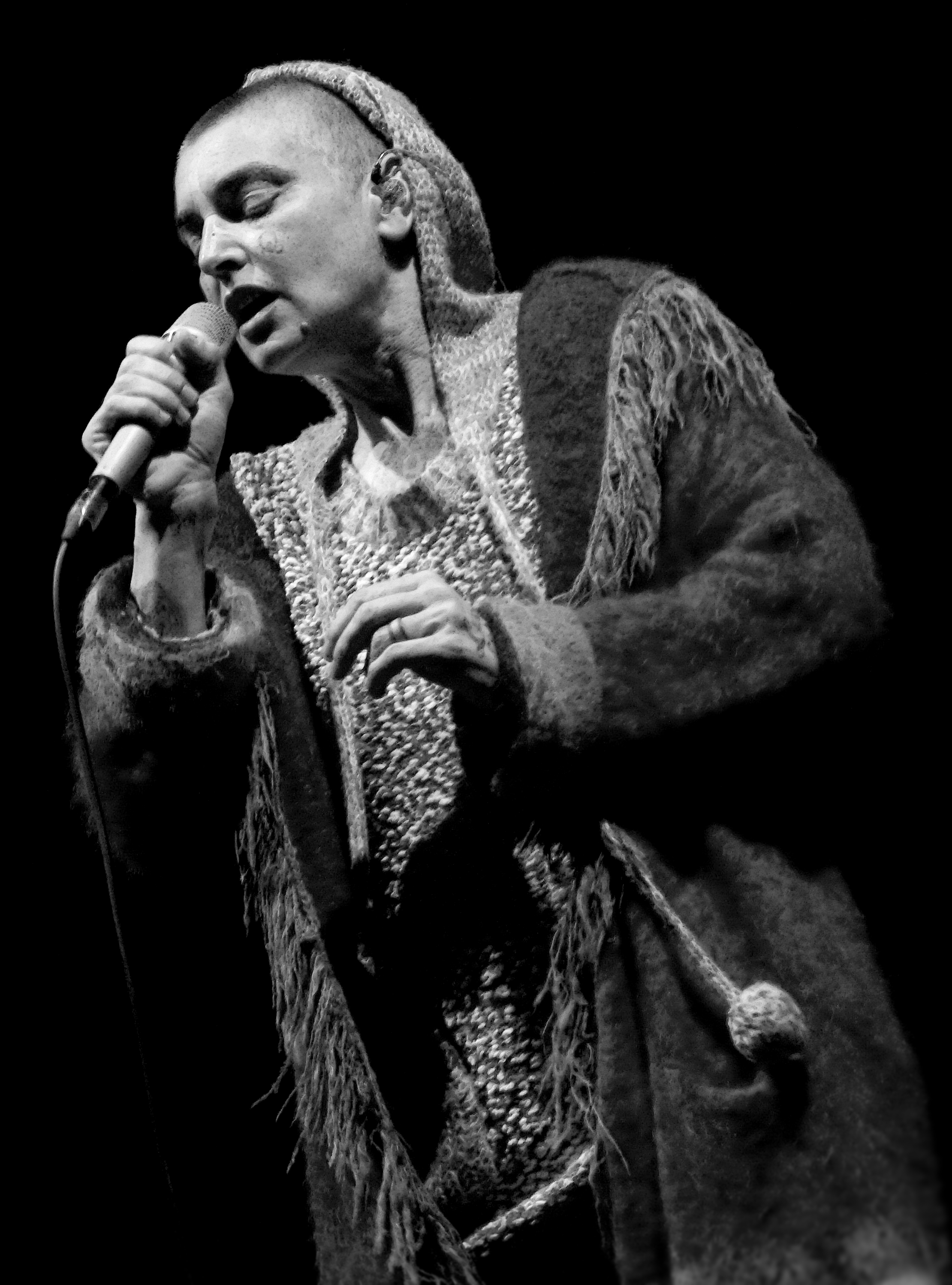
Sinéad O’Connor at Ramsbottom Music Festival, 2013 (cropped) Photo: Man Alive!; crop by A1Cafel. Cropped version from Wikimedia Commons. Photo sourceCC BY 2.0
Alternative · 8 min read
Sinead o’ Conner
Sinéad O’Connor had a voice that could stop everything around it. She could sing with extraordinary force, then soften to a near whisper without losing any of the intensity. Anger, tenderness, grief and affection all had a place in her performances. The feeling often seemed close to the surface, giving the impression that each word mattered too much to be delivered casually. Her music asked people to listen closely, and her voice gave them every reason to do so.
Born in Dublin in 1966, O’Connor developed an artistic identity that was unmistakably her own. Her shaved head became an instantly recognisable part of her appearance, while her music established a singer with both remarkable control and a willingness to take risks. She could bring a fierce presence to a rock arrangement or hold attention with very little accompaniment. Across her work, there is a strong sense of someone choosing how she wants to be heard.
Her debut album, The Lion and the Cobra, released in 1987, introduced that range with striking confidence. “Mandinka” moves with a driving energy, allowing her voice to cut through the guitars and rhythm. “Troy” unfolds more dramatically, beginning with restraint before reaching passages of almost overwhelming intensity. The album makes clear how much expression she could find within a single performance. A change in breath, emphasis or volume could transform the meaning of a phrase.
Her interpretation of Prince’s “Nothing Compares 2 U” brought her worldwide recognition in 1990. The arrangement gives her voice room, and she uses that space with extraordinary care. There is loneliness in the quieter lines and a growing ache as the song develops. The famous video, centred largely on her face, makes the performance feel even more exposed. A song written by someone else becomes, through her delivery, an entirely convincing account of loss.
The album that carried it, I Do Not Want What I Haven’t Got, offers a much wider picture of her abilities. “The Emperor’s New Clothes” has a restless confidence, while “Black Boys on Mopeds” turns a restrained musical setting into pointed social commentary. Personal experience and concern for the wider world sit close together in her writing. She could examine a relationship, challenge an injustice or question an accepted belief with the same commitment to saying what she meant.
Her musical curiosity took her across several traditions. Am I Not Your Girl? explored standards, placing her voice within orchestral arrangements. Sean-Nós Nua drew on Irish traditional song, bringing her sensitivity to storytelling and phrasing into another setting. On Throw Down Your Arms, she interpreted roots reggae songs with musicians connected to that tradition. These records reveal an artist interested in what a song could communicate and how her voice might find its place inside it.
O’Connor was also outspoken about abuse, religious authority and the treatment of vulnerable people. Her public actions sometimes brought intense hostility and overshadowed discussion of her music. Her 1992 appearance on Saturday Night Live, when she tore up a photograph of Pope John Paul II in protest against abuse within the Catholic Church, became a defining example. It was an act that carried serious consequences for her career and later prompted many people to reconsider how she had been treated.
Yet any description of Sinéad O’Connor should leave room for the tenderness in her work. The force of her public presence could obscure how gently she could approach a melody. She understood the power of an unhurried line and could make a simple song feel almost private. That softness was an essential part of her artistry, giving her more confrontational performances greater depth.
O’Connor died in 2023, leaving recordings that continue to carry the full character of her voice. Her legacy includes musical invention, difficult truths and performances of exceptional emotional clarity. Listen to the way she holds a note or allows a phrase to fall away, and the connection remains immediate. She gave songs her complete attention, and in doing so made listeners feel that something important was being entrusted to them.
Sinéad O’Connor, Kate Nash and “Famine” — A Song That Refuses to Forget
Some songs exist simply to entertain. Others carry history inside them. Sinéad O’Connor’s “Famine” belongs firmly in the second category. Released on her 1994 album Universal Mother, the track was unlike an ordinary pop song. O’Connor combined spoken word, hip-hop-inspired rhythm and traditional ideas about Irish identity to confront the Great Hunger, colonial history and the emotional damage she believed had been carried through generations. Rather than treating history as something safely left in the past, she used music to ask what happens when a country has never fully processed what happened to its people. The Line of Best Fit
That willingness to say uncomfortable things was central to Sinéad O’Connor as an artist. She could be vulnerable one moment and confrontational the next, but there was usually a reason behind the intensity. “Famine” was not written as a history lesson in the conventional sense. It was O’Connor presenting an argument about Ireland, memory and trauma through music. Some of the historical claims and language in the song are deliberately forceful and have been debated, but the heart of the piece is unmistakable: people cannot properly understand themselves if important parts of their history are forgotten or ignored.
More than three decades later, Kate Nash returned to that song.
Following O’Connor’s death in 2023, Nash revisited her music and found herself particularly drawn to “Famine”. Nash has Irish family connections through her mother, who was born in Dublin, and in recent years she has been exploring that side of her identity more deeply through her own music. She has spoken about growing up with Irish dancing, holidays in Ireland and music such as Christy Moore and The Dubliners around her. Kate Nash
Instead of choosing one of Sinéad’s more famous songs, Nash chose one of her most challenging.
Her version of “Famine” was released on 10 April 2026, after she had performed it at a sold-out show at London’s Roundhouse. It was not intended to be an exact recreation. Nash added an original verse of her own, bringing the song into another generation while keeping Sinéad’s central message intact. She also played tin whistle, remarkably returning to the first instrument she had learned. Kate Nash
The recording surrounds Nash with unmistakably Irish sounds. Bodhrán, harp, banjo, uilleann pipes and fiddle sit alongside bass, drums, synthesisers and electronic production. That mixture feels appropriate for a song connecting history with the present: traditional instruments are not placed inside a museum; they live beside contemporary production. Kate Nash
There is also something significant about one female songwriter carrying another female songwriter’s words forward.
Kate Nash and Sinéad O’Connor are very different artists from different musical generations. Sinéad could move from almost whispered intimacy to a voice that seemed capable of cutting straight through everything around it. Nash first became widely known through the conversational, unmistakably British indie-pop writing of songs such as “Foundations”, later moving through punk, rock, theatre-influenced pop and independent music.
Yet there is a connection between them. Neither has seemed particularly interested in behaving exactly as the music industry expects a female performer to behave.
Sinéad repeatedly used her platform to talk about subjects much larger than record sales. Kate Nash has likewise become increasingly outspoken about musicians, the industry, identity and issues she considers important. Covering “Famine” therefore feels less like Nash borrowing an old song and more like entering a conversation Sinéad began years earlier.
Nash has said that her intention was to honour Sinéad’s voice and continue spreading the message rather than replacing it. Her version also became connected to a wider project exploring her Irish heritage. During 2026 she performed new material in Ireland, with shows and appearances connected to that developing body of work. RTE
Perhaps that is what makes this cover particularly interesting.
A cover version normally asks, “What can I do differently with this song?”
This one asks another question:
“Why does this song still need to be sung?”
Sinéad O’Connor recorded “Famine” in the 1990s because she believed remembering was necessary before genuine healing could happen. More than thirty years later, Kate Nash heard those words and decided they still deserved an audience.
The voices are different. The generations are different. The musical surroundings have changed.
But the conversation continues.
And in that sense, Kate Nash’s version may be one of the strongest tributes she could have made to Sinéad O’Connor. She did not simply sing one of Sinéad’s songs because it was beautiful or famous. She chose one that demanded something from the listener.
Sinéad used music to remember.
Kate Nash has picked up that memory and carried it forward.
Loading comments…