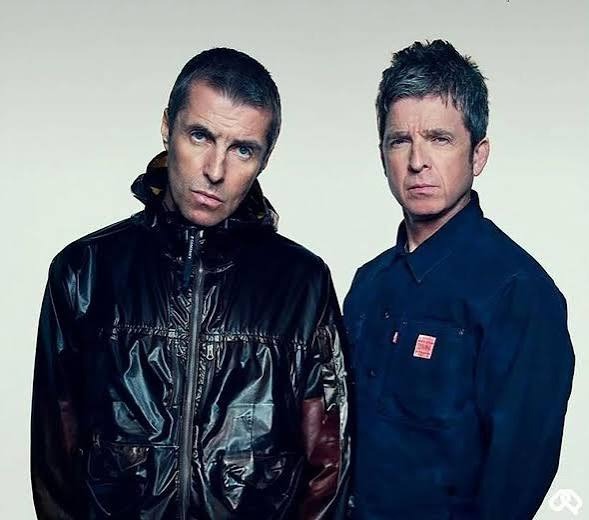
Image from TheFatLlama.net · Original artist feature
Rock · 5 min read
Oasis
Oasis made everyday ambition sound enormous. Their music took the frustrations of ordinary life, mixed them with swagger and melody, and turned them into songs that crowds could claim as their own. There is a strong sense of wanting more in their records: more freedom, better nights, a different future and something worth believing in. Even when the lyrics drift into dreamlike images, the feeling remains direct. These are songs that invite you to lift your head, turn up the volume and join in.
Formed in Manchester in 1991, Oasis became one of the defining British bands of the 1990s. At the centre were brothers Liam and Noel Gallagher, whose different musical strengths helped shape the band’s identity. Liam brought a voice with bite, confidence and a distinctive way of stretching a phrase. Noel supplied the songwriting behind most of their best-known work, pairing memorable melodies with guitar arrangements that could make a straightforward song feel monumental. Their contrasting personalities added tension to a partnership that produced an extraordinary run of records.
Liam’s singing is essential to the Oasis sound. His delivery can seem almost motionless on the surface, yet there is considerable attitude in the way he attacks a word or holds a vowel. He can make a lyric sound dismissive, hopeful or defiant through phrasing alone. On the louder songs, his voice cuts through the guitars with a sharp, nasal edge. In gentler moments, a more vulnerable quality comes through, giving the confidence something human underneath it.
Their debut album, Definitely Maybe, arrived in 1994 with an unmistakable hunger. “Rock ’n’ Roll Star” turns the fantasy of escaping an ordinary existence into a loud declaration of possibility. “Live Forever” brings warmth and conviction to a melody that feels generous enough for anyone to step inside. “Supersonic” has a heavier, unhurried groove, allowing Liam’s delivery and the guitar lines to establish their own momentum. The album captures the excitement of a band convinced that something bigger is within reach.
With (What’s the Story) Morning Glory?, Oasis gave that ambition an even broader musical shape. “Wonderwall” builds around acoustic guitar, a steady rhythm and a vocal full of need and uncertainty. “Don’t Look Back in Anger,” sung by Noel, combines a welcoming piano introduction with a chorus that has become a shared language between generations of listeners. “Champagne Supernova” allows the band to stretch out, using atmosphere and repetition to create a sweeping, slightly mysterious finish. The songs differ in mood, but each gives melody the space to do much of the emotional work.
Their guitars are a major part of that experience. Layers of distortion create weight, while lead phrases often echo the directness of the vocal melodies. Bass and drums keep the songs grounded, giving the arrangements a solid forward movement. There is pleasure in that physical sound: chords ringing together, a rhythm holding firm and a voice rising above it all. At their best, Oasis make those familiar ingredients feel completely absorbing.
There is also far more tenderness in their catalogue than their confrontational reputation might suggest. Songs such as “Talk Tonight” and “Half the World Away” reveal Noel’s ability to write about exhaustion, gratitude and the desire to escape with a lighter touch. These quieter recordings show how well the songs can work with little surrounding them. The melody and the emotional suggestion remain strong enough to carry the performance.
Part of the appeal of Oasis lies in how much room their songs leave for listeners. A line does not always need a precise explanation to connect with a particular memory or feeling. Hope, loneliness, affection and frustration can exist together inside a chorus, allowing different people to hear different things. That openness helps a song move from a private listen through headphones to a moment shared by an entire crowd.
Oasis gave British rock a voice that could be cocky, funny, weary and unexpectedly moving. Their records preserve the excitement of believing your surroundings do not have to define your future. Put on “Live Forever” or let the chorus of “Don’t Look Back in Anger” arrive, and that feeling is still easy to understand: for a few minutes, the world opens up, and everyone knows where to come in.
Here are Oasis’s 2027 dates currently listed on their official website.
Oasis
Location Venue Dates in 2027
Glasgow
Celtic Park
25, 28, 29 May
Manchester
Etihad Stadium
4, 6, 8, 11, 12, 15, 18, 19, 22, 25, 26 June
Munich
Allianz Arena
2, 3, 6 July
Barcelona
Estadi Olímpic Lluís Companys
10, 11 July
Amsterdam
Johan Cruijff ArenA
16, 17 July
Paris
Stade de France
20, 23 July
Rome
Stadio Olimpico
26, 29, 30 July
Boston area
Gillette Stadium
10, 13, 14 August
Las Vegas
Allegiant Stadium
20, 21, 24 August
Meath, Ireland
Slane Castle
4, 5 September
Hertfordshire
Knebworth Park
11, 12, 18, 19, 25, 26 September
Watch Oasis
Half the World Away
Watch on YouTube ↗YouTube loads when you press play. Some videos may need to open on YouTube.
Start with these
- Live Forever
- Wonderwall
- Don’t Look Back in Anger
Listening opens in your chosen service. Availability and subscription requirements may vary.
What do you think?
Join the conversation about Oasis.
Loading comments…