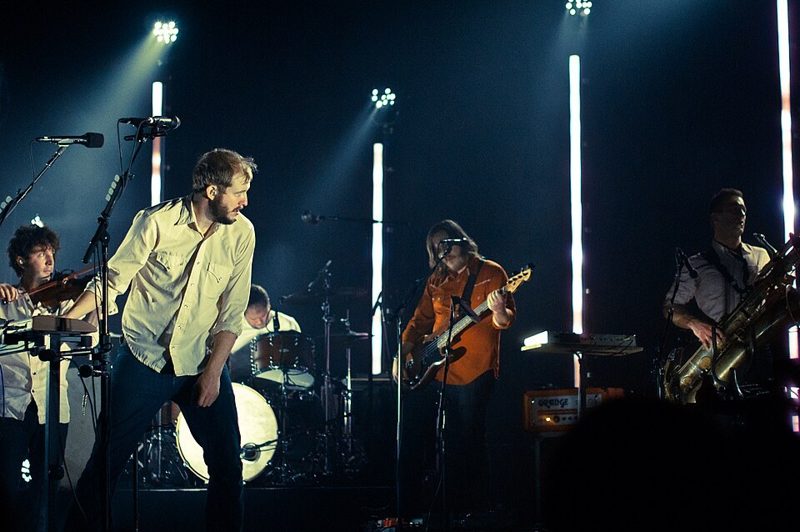
Photo: danieljordahl from Östersund, Sweden. Resized for this app.
Photo sourceCC BY 2.0
Alternative · 5 min read
Bon Iver
Bon Iver makes music that gives complicated feelings room to breathe. A song can begin with a fragile voice and a few quiet notes, then gradually open into layers of sound that feel almost overwhelming. There is tenderness in the music, but also tension, distance and uncertainty. Even when the words are difficult to untangle, the emotion often arrives clearly. It is music that can meet you in a particular moment and take on a different meaning when you return to it years later.
Founded by American songwriter and musician Justin Vernon, Bon Iver first became widely known through For Emma, Forever Ago. Much of that debut was recorded during a period of isolation in a Wisconsin cabin, and its intimate atmosphere became an essential part of the project’s early identity. Acoustic guitars, layered vocals and restrained arrangements created the feeling of being close to someone working through thoughts they could barely say aloud. Songs such as “Skinny Love” and “Flume” carry a striking vulnerability, with performances that leave their strain and imperfections exposed.
Vernon’s voice remains one of Bon Iver’s most distinctive instruments. His falsetto can sound delicate, distant or suddenly forceful, sometimes shifting between those qualities within a single phrase. When several vocal parts gather around one another, they create a sense of company without entirely removing the loneliness. Elsewhere, his lower register brings warmth and weight. The emotional effect comes as much from the shape of the singing as from the words: a stretched syllable, an unfinished phrase or a change in tone can carry the heart of a song.
As Bon Iver developed, the music grew beyond the spare surroundings of the debut. The self-titled album opened into a broader landscape of guitars, percussion, keyboards and brass. Its arrangements have a spacious quality, allowing individual sounds to emerge and disappear without breaking the mood. Tracks such as “Holocene” and “Perth” show how naturally the project can move between quiet reflection and powerful release. There is a strong sense of place in this music, although the places it suggests can feel as much imagined or remembered as physical.
With 22, A Million, that openness took a more fractured form. Electronic textures, altered vocals and abrupt shifts brought a different kind of beauty into the work. Sounds crackle, interrupt one another and occasionally seem close to falling apart. Within those disruptions, a melody or an exposed voice can feel especially moving. The production becomes part of the emotional language, giving uncertainty an audible shape. Bon Iver’s willingness to let technology sound vulnerable is one of the most compelling aspects of its evolution.
That adventurous approach also makes Bon Iver difficult to place within a single genre. Folk remains part of its foundation, but elements of electronic music, soul, gospel and experimental pop move through the catalogue. Collaboration allows the sound to keep changing, with different musicians contributing to arrangements that feel carefully built yet open to surprise. Across those changes, the attention to atmosphere remains consistent. Small details matter, and repeated listening can reveal an instrumental line or vocal harmony that changes the balance of an entire song.
The lyrics often work through fragments and associations rather than straightforward storytelling. Images, memories and unusual turns of phrase leave space for interpretation. You may understand the feeling of a line before deciding what it means, or find that its meaning depends on what you bring to it. This openness gives the music a personal quality without requiring every listener to share the same experience.
Bon Iver’s lasting appeal lies in the care given to emotions that are hard to explain. Grief, affection, doubt and wonder can sit close together, sometimes within the same passage. The music can be comforting without offering an easy resolution, and expansive without losing its intimacy. Whether carried by an acoustic guitar or surrounded by restless electronic sound, there is usually a human voice reaching through—hesitant at times, powerful at others, and worth listening closely to.
Bon Iver’s VOLUMES: ONE brings together live performances that show how much a song can grow once it reaches the stage. Released in 2026, the collection offers a different way to explore the band’s music, with Justin Vernon and his fellow musicians sharing the spotlight. For me, the appeal of a release like this is the chance to revisit songs through performances that belong to a particular place and moment.
Bon Iver has always had a way of making deeply personal music feel open to everyone. There is room for sadness, hope, uncertainty and comfort, often without spelling out exactly what the listener should feel. A live collection suits that approach. Songs that people have listened to privately become something shared between the band and an audience, bringing another dimension to their meaning.
With tracks including “Heavenly Father,” “Hey, Ma” and “33 ‘GOD’,” VOLUMES: ONE draws from different parts of Bon Iver’s catalogue. The selection offers longtime fans familiar starting points while giving newer listeners a chance to discover the band through its concert performances. It also puts the focus on the group as a whole. Vernon’s voice is a defining part of Bon Iver, but the musicians around him help give these songs their shape and character.
What interests me most is the idea that a song is never completely finished. The studio recording becomes the version we know, but performing it creates opportunities to approach it again. Time can change the relationship an artist has with their own words, just as our experiences can change what we hear in them. That makes looking back through live recordings feel worthwhile.
As the beginning of an archival series, VOLUMES: ONE gives listeners a closer connection to Bon Iver’s history onstage. It celebrates the work of a band coming together around songs that continue to mean something to people. Whether you have followed Bon Iver for years or are only beginning to explore the music, this collection offers a reason to spend more time with it.
Watch Bon Iver
S P E Y S I D E
Watch on YouTube ↗YouTube loads when you press play. Some videos may need to open on YouTube.
Start with these
- Skinny Love
- Holocene
- 33 “GOD”
Listening opens in your chosen service. Availability and subscription requirements may vary.
What do you think?
Join the conversation about Bon Iver.
Loading comments…